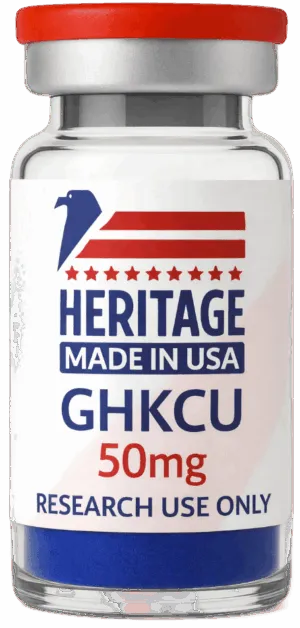
GHK-Cu 50mg: Educational Research, Mechanism & Safety
GHK-Cu 50mg refers to a stated 50mg quantity of GHK-Cu (copper tripeptide), a naturally occurring copper-binding peptide that has been investigated for its potential roles in skin biology, wound-healing processes, inflammation, and tissue remodeling.
GHK-Cu is scientifically different from many synthetic research peptides because the GHK peptide occurs naturally in the human body and can bind copper ions. However, a product labeled 50mg should not automatically be interpreted as an approved therapeutic dose.
What Is GHK-Cu?
GHK-Cu stands for glycyl-L-histidyl-L-lysine copper, commonly called copper tripeptide-1.
GHK is a small three-amino-acid peptide that can form a complex with copper. Research has investigated GHK-Cu in relation to processes involved in extracellular matrix remodeling, collagen production, cellular signaling, and tissue repair.
Because of these properties, GHK-Cu has attracted interest in both dermatological and biochemical research.
How Does GHK-Cu Work?
GHK-Cu is thought to interact with several biological pathways involved in tissue maintenance and repair.
Research has investigated its potential influence on:
- Collagen and extracellular-matrix activity
- Fibroblast function
- Skin remodeling
- Inflammatory signaling
- Cellular migration
- Wound-healing processes
- Oxidative-stress responses


These mechanisms are scientifically interesting, but laboratory evidence should not be interpreted as proof that every GHK-Cu formulation provides a particular clinical benefit.
GHK-Cu and Skin Research
One of the most recognized areas of GHK-Cu research involves skin biology.
Studies have explored whether copper peptides can influence extracellular-matrix proteins and processes involved in maintaining skin structure. Research has particularly focused on collagen-related activity and tissue remodeling.
This has contributed to the inclusion of copper peptides in some cosmetic and skincare formulations.
However, the effects of a topical cosmetic preparation should not automatically be assumed to apply to every product containing GHK-Cu, particularly products formulated for research rather than cosmetic use.
GHK-Cu and Wound-Healing Research
GHK-Cu has also been studied in experimental models of tissue repair.
Researchers have investigated processes such as:
- Fibroblast activity
- Blood-vessel formation
- Cell migration
- Extracellular-matrix remodeling
- Inflammatory responses
These findings have generated interest in GHK-Cu as a potential research compound for tissue biology.
Nevertheless, more rigorous human research is needed before broad therapeutic claims can be established.
What Does “50mg” Mean?
The 50mg designation indicates the stated amount of GHK-Cu associated with a particular product or formulation.
It does not establish an FDA-approved dose.
The concentration, purity, formulation, route of administration, and manufacturing standards can vary between products. Consequently, a “GHK-Cu 50mg” label should be treated as a product specification rather than a medically validated dosage recommendation.
Potential Research Areas
Skin Biology
GHK-Cu has been studied for its relationship with collagen, extracellular-matrix remodeling, and other processes involved in skin structure.
Tissue Repair
Experimental research has examined the peptide’s potential involvement in cellular processes associated with tissue repair.
Inflammation
Researchers have investigated possible interactions between GHK-Cu and inflammatory signaling pathways.
Cosmetic Science
Copper peptides have been incorporated into some cosmetic formulations, particularly products designed around skin-conditioning and appearance-related claims.
Cellular Research
GHK-Cu provides a useful model for studying interactions between small peptides and copper-dependent biological processes.
Is GHK-Cu FDA Approved?
GHK-Cu is not an FDA-approved drug for treating medical conditions.
The regulatory status depends on how a particular GHK-Cu product is formulated and marketed. A cosmetic containing a copper peptide is not equivalent to an FDA-approved pharmaceutical product.
Therefore, a product marketed as GHK-Cu 50mg should not be described as an FDA-approved treatment for wound healing, hair loss, aging, or other medical conditions.
Safety Considerations
The safety profile of GHK-Cu depends heavily on the formulation and route of administration.
Important considerations for research products include:
- Purity
- Potency
- Contamination
- Product identity
- Manufacturing quality
- Stability
- Route of administration
There is also limited clinical evidence supporting many of the broader claims commonly associated with GHK-Cu research products.
Consumers should therefore avoid assuming that a product marketed online has the same quality or safety characteristics as a regulated pharmaceutical or established cosmetic formulation.
Frequently Asked Questions
What is GHK-Cu 50mg?
GHK-Cu 50mg refers to a product labeled as containing 50mg of the copper-binding peptide GHK-Cu.
What is GHK-Cu researched for?
Research has examined GHK-Cu in relation to skin biology, collagen and extracellular-matrix activity, inflammation, cellular signaling, and tissue repair.
Is GHK-Cu a peptide?
Yes. GHK-Cu is a copper-binding complex involving the tripeptide GHK.
Is GHK-Cu FDA approved?
No. GHK-Cu is not an FDA-approved drug for treating medical conditions.
Does GHK-Cu improve skin?
Copper peptides have been studied in relation to skin structure and remodeling, and GHK-Cu is used in some cosmetic formulations. However, evidence varies by formulation and application, so broad therapeutic claims should be avoided.
Conclusion
GHK-Cu 50mg is a copper-binding peptide product associated with research into skin biology, collagen-related processes, cellular signaling, inflammation, and tissue remodeling.
Although GHK-Cu has attracted considerable scientific and cosmetic interest, the evidence for many therapeutic claims remains limited. A 50mg product label represents a stated quantity, not an FDA-approved therapeutic dose, and the quality and safety of individual products can vary.
Educational disclaimer: This content is for educational and SEO purposes only. It is not medical advice and does not provide individualized dosing, preparation, administration, purchasing, or treatment instructions.
Reviews
There are no reviews yet.