GLOW 50/10/10: Educational Research, Potential Uses & Safety
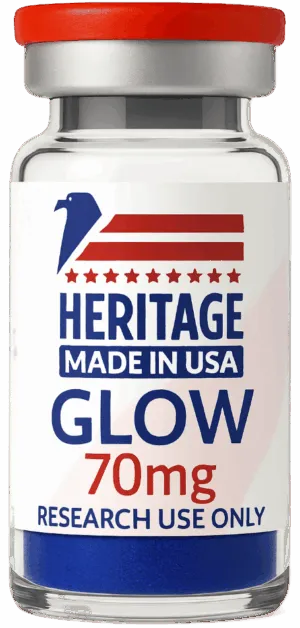
GLOW 50/10/10 is a research peptide blend commonly described as containing GHK-Cu 50 mg, BPC-157 10 mg, and TB-500 10 mg, for a total of 70 mg of peptide material. Multiple research-product listings use this formulation.
The three compounds have been investigated separately in areas involving skin biology, tissue signaling, inflammation, and cellular repair. However, peer-reviewed research has not established the GLOW 50/10/10 combination itself as a clinically proven treatment.
What Is GLOW 50/10/10?
GLOW is a multi-peptide research formulation combining three compounds:
- GHK-Cu — 50 mg
- BPC-157 — 10 mg
- TB-500 — 10 mg
The name “50/10/10” refers to the stated amounts of these three components.
Because commercial formulations can vary, the actual ingredient list should always be verified against the specific product documentation rather than relying solely on the product name.
GHK-Cu Research
GHK-Cu, or copper tripeptide-1, is a copper-binding peptide studied in relation to skin biology, collagen-related processes, extracellular-matrix remodeling, and wound-healing research.
Its biological activity has generated interest in cosmetic and laboratory research. However, evidence involving specific topical or experimental applications should not automatically be interpreted as proof that a GLOW blend produces the same effects in humans.
The FDA has identified limited human safety information and potential immunogenicity concerns for compounded injectable GHK-Cu.
BPC-157 Research
BPC-157 is an experimental peptide investigated primarily through laboratory and animal studies.
Research has examined potential relationships with:
- Tissue biology
- Gastrointestinal pathways
- Inflammatory signaling
- Cellular repair
- Blood-vessel formation
Despite considerable interest, human evidence remains limited. The FDA has identified concerns involving immunogenicity, peptide impurities, and limited safety information for proposed routes of administration.
TB-500 Research
TB-500 is commonly described as a fragment related to thymosin beta-4. Research involving thymosin-beta-4-related pathways has explored cellular migration, tissue remodeling, and vascular processes.
However, human evidence for TB-500 itself is extremely limited. The FDA reports that it has not identified human exposure data for drug products containing TB-500 and notes concerns regarding aggregation, peptide impurities, and unknown safety risks.
Potential Research Areas
The individual components of GLOW have generated interest in research involving:
- Skin and connective-tissue biology
- Collagen-related pathways
- Cellular signaling
- Tissue remodeling
- Inflammatory pathways
- Wound-healing mechanisms
- Extracellular-matrix research
These should be described as research areas rather than proven medical benefits.
Is GLOW 50/10/10 FDA Approved?
No. GLOW 50/10/10 is not an FDA-approved medication.
The individual ingredients also have different regulatory and evidence profiles. The FDA has specifically identified safety-information gaps concerning BPC-157, injectable GHK-Cu, and TB-500.
A product being labeled “research use only” does not establish that it has been evaluated or approved for human therapeutic use.
Safety Considerations
Important considerations when evaluating experimental peptide blends include:
- Limited long-term human safety data
- Potential immunogenicity
- Peptide impurities
- Variable manufacturing quality
- Incorrect labeling or concentration
- Contamination
- Unknown effects of combining multiple peptides
A laboratory certificate of analysis may provide information about a particular tested batch, but it does not establish clinical effectiveness or regulatory approval. One publicly available GLOW certificate, for example, explicitly states that its testing was for research purposes and not for therapeutic or clinical applications.
Frequently Asked Questions
What is GLOW 50/10/10?
It is commonly marketed as a three-peptide research blend containing 50 mg GHK-Cu, 10 mg BPC-157, and 10 mg TB-500.
What is GLOW researched for?
The individual ingredients have been studied in areas including skin biology, tissue remodeling, cellular signaling, and inflammatory pathways.
Is GLOW 50/10/10 proven to improve skin or healing?
No. There is insufficient clinical evidence establishing the complete GLOW formulation as an effective treatment.
Is GLOW 50/10/10 FDA approved?
No. It should be considered an experimental research formulation rather than an FDA-approved medicine.
Is GLOW the same as KLOW?
No. GLOW 50/10/10 commonly contains GHK-Cu, BPC-157, and TB-500, whereas KLOW formulations may add KPV.
Conclusion
GLOW 50/10/10 is a multi-peptide research blend commonly consisting of GHK-Cu, BPC-157, and TB-500. Its individual components have attracted scientific interest in areas such as tissue biology, skin research, cellular signaling, and inflammatory pathways.
Nevertheless, the combination itself has not been established as a clinically proven therapy, and important questions remain regarding human safety and long-term effects.
Educational disclaimer: This article is for educational and SEO purposes only. It is not medical advice and does not provide dosing, preparation, administration, purchasing, or treatment instructions.



Reviews
There are no reviews yet.