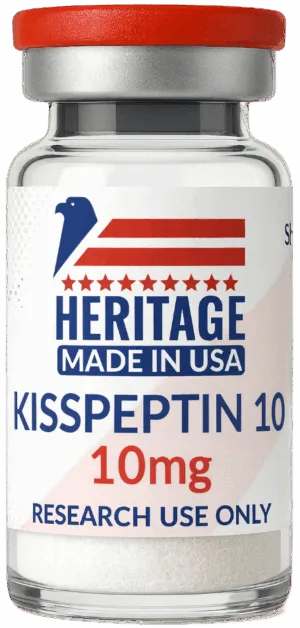
Kisspeptin-10 10mg: Educational Research, Mechanism & Safety Guide
Kisspeptin-10 10mg refers to a stated quantity of Kisspeptin-10 (KP-10), a short peptide fragment derived from the larger kisspeptin family. Kisspeptin signaling is particularly important in research concerning the hypothalamic–pituitary–gonadal (HPG) axis, reproductive hormone regulation, and puberty.
Kisspeptin-10 is an investigational research compound and should not be presented as an FDA-approved treatment. The “10mg” designation describes the stated quantity of a particular product and is not an established therapeutic dose.
What Is Kisspeptin-10 10mg?
Kisspeptins are peptides encoded by the KISS1 gene. They activate the KISS1 receptor (KISS1R), also known as the GPR54 receptor.
Kisspeptin signaling plays a key role in regulating the release of gonadotropin-releasing hormone (GnRH) from the hypothalamus. GnRH subsequently influences the pituitary hormones LH (luteinizing hormone) and FSH (follicle-stimulating hormone).
Because of this central role, kisspeptin has become an important subject of endocrine and reproductive research.
How Does Kisspeptin-10 10mg Work?
Kisspeptin-10 binds to and activates the KISS1R receptor.
This signaling can stimulate GnRH neurons, which are involved in controlling reproductive hormone production.
The pathway can be summarized as:
Kisspeptin → KISS1R → GnRH → LH/FSH → reproductive hormone signaling
Researchers use this pathway to investigate how the brain communicates with the reproductive system.
Kisspeptin-10 and Reproductive Research
One of the major research areas involving Kisspeptin-10 is reproductive endocrinology.
Studies have investigated kisspeptin signaling in relation to:
- Puberty
- Fertility
- Ovulation
- Gonadal function
- LH and FSH secretion
- Testosterone and estrogen regulation
- Reproductive hormone signaling
Kisspeptin is particularly interesting because it acts upstream of several important reproductive hormones.
Kisspeptin and Fertility Research
Researchers have investigated kisspeptin as a potential tool for understanding reproductive disorders and fertility.
Experimental and clinical studies have examined whether stimulating kisspeptin pathways can influence reproductive hormone release and reproductive function.
However, research findings should not be interpreted as evidence that commercially marketed Kisspeptin-10 products are proven fertility treatments.
Kisspeptin and Puberty Research
Kisspeptin signaling is strongly associated with the biological transition into puberty.
Increasing kisspeptin activity is thought to contribute to activation of GnRH neurons, which subsequently increases reproductive hormone signaling.
This makes the kisspeptin pathway an important subject of research into both normal puberty and disorders involving delayed or abnormal pubertal development.
What Does “10mg” Mean?
The 10mg designation indicates the stated amount of Kisspeptin-10 associated with a particular product.
It does not represent an FDA-approved dosage.
Research studies can use different quantities, formulations, and administration methods, so a commercial product labeled “Kisspeptin-10 10mg” should not automatically be equated with the formulations used in clinical research.
Potential Research Areas
Reproductive Endocrinology
Kisspeptin is an important regulator of the reproductive hormone axis and is extensively studied in endocrinology.
Fertility
Researchers are investigating kisspeptin signaling as a potential way to understand reproductive hormone dysfunction and fertility.
Puberty
The kisspeptin-KISS1R pathway has an important role in initiating and regulating reproductive maturation.
Hormone Regulation
Kisspeptin can influence GnRH and downstream LH and FSH secretion, making it relevant to hormone-regulation research.
Is Kisspeptin-10 FDA Approved?
No.
Kisspeptin-10 is not an FDA-approved medication for fertility, testosterone enhancement, hormone replacement, puberty disorders, or other general medical purposes.
A product labeled Kisspeptin-10 10mg should therefore be described accurately as an investigational or research compound rather than an approved pharmaceutical.
Safety Considerations
The long-term safety profile of Kisspeptin-10 has not been established for routine medical use.
Because kisspeptin directly influences reproductive hormone signaling, potential effects on endocrine function are an important area for further investigation.
Research-product concerns can also include:
- Limited long-term human data
- Product purity
- Incorrect labeling
- Variable potency
- Contamination
- Unknown interactions with medications
- Uncertain effects from prolonged exposure
Anyone considering an experimental compound for fertility or hormonal purposes should discuss the issue with a qualified healthcare professional.
Frequently Asked Questions
What is Kisspeptin-10 10mg?
It refers to a product labeled as containing 10mg of Kisspeptin-10, an experimental peptide involved in reproductive hormone signaling.
What does Kisspeptin-10 do?
Kisspeptin-10 activates KISS1R and can stimulate pathways involving GnRH, LH, and FSH.
Is Kisspeptin-10 a peptide?
Yes. Kisspeptin-10 is a short peptide derived from the kisspeptin family.
Is Kisspeptin-10 FDA approved?
No. It is not an FDA-approved medication.
Is 10mg an established therapeutic dose?
No. The 10mg designation represents a stated product quantity rather than an FDA-approved therapeutic dose.
Conclusion
Kisspeptin-10 10mg is an investigational peptide with an important role in research into the hypothalamic–pituitary–gonadal axis and reproductive hormone regulation.
By activating KISS1R, kisspeptin signaling can influence GnRH and downstream reproductive hormones. This has made the pathway an important area of research involving fertility, puberty, and endocrine function.
However, Kisspeptin-10 remains investigational, and the 10mg product designation should not be presented as an established therapeutic dose.
Educational disclaimer: This content is for educational and SEO purposes only. It is not medical advice and does not provide individualized dosing, preparation, administration, purchasing, or treatment instructions.

Reviews
There are no reviews yet.