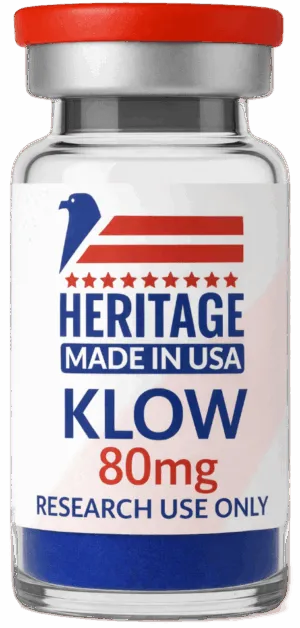
KLOW 80mg: Educational Research, Composition & Safety
KLOW 80mg is a research peptide blend commonly described as a combination of GHK-Cu, BPC-157, TB-500 (thymosin-beta-4–related material), and KPV. The commonly listed 80mg formulation contains 50mg GHK-Cu, 10mg BPC-157, 10mg TB-500, and 10mg KPV.
Importantly, KLOW is a research-only combination rather than an FDA-approved medicine, and the blend itself has not been adequately tested in controlled human clinical studies.
What Is KLOW?
KLOW 80mg is not a single peptide or newly synthesized molecule. It is a multi-peptide research formulation containing four separate compounds.
Each component has attracted scientific interest for different biological pathways:
- GHK-Cu: investigated in skin, collagen, and extracellular-matrix research
- BPC-157: investigated primarily in preclinical tissue-repair and gastrointestinal research
- TB-500: associated with research into thymosin-beta-4-related cellular migration and wound-healing pathways
- KPV: investigated for anti-inflammatory and gastrointestinal pathways
These individual research findings provide the rationale for studying the combination, but they do not demonstrate that KLOW itself produces the same effects in humans.
What Does “80mg” Mean?
The 80mg designation generally refers to the total peptide material in the research vial.
A commonly listed composition is:
| Component | Stated amount |
|---|---|
| GHK-Cu | 50mg |
| BPC-157 | 10mg |
| TB-500 | 10mg |
| KPV | 10mg |
| Total | 80mg |
This is a product composition, not a validated human dosage. No controlled clinical study has established an appropriate KLOW dose or dosing schedule for people.
GHK-Cu Research
GHK-Cu is a copper-binding tripeptide that has been investigated in relation to collagen production, extracellular-matrix remodeling, skin biology, and cellular signaling.
Its presence in KLOW is one reason the blend has attracted interest in research involving tissue and skin biology.
However, findings involving GHK-Cu alone cannot establish the effectiveness of the complete KLOW formulation.
BPC-157 Research
BPC-157 is an experimental peptide investigated primarily in preclinical models.
Research has examined potential relationships with tissue repair, gastrointestinal processes, vascular signaling, and inflammatory pathways.
Despite considerable online interest, there remains insufficient clinical evidence to establish BPC-157 as an approved treatment for injuries or other medical conditions.
TB-500 Research
TB-500 is commonly associated with thymosin-beta-4-related research involving cell migration, tissue remodeling, and wound-healing processes.
An important distinction is that evidence involving naturally occurring or full-length thymosin beta-4 should not automatically be considered evidence specifically establishing the safety or effectiveness of commercial TB-500 products.
KPV Research
KPV is a short peptide consisting of three amino acids. Experimental research has investigated its potential relationship with inflammatory signaling and gastrointestinal inflammation.
Again, these findings are primarily preclinical and do not establish KLOW as a clinically proven anti-inflammatory treatment.
Why Combine These Four Peptides?
The scientific rationale behind KLOW is that its four components are associated with different biological pathways.
Researchers may therefore investigate the combination in relation to:
- Tissue biology
- Cellular migration
- Extracellular-matrix remodeling
- Inflammatory signaling
- Skin research
- Wound-healing mechanisms
However, the combined formulation remains largely untested. A theoretical combination of mechanisms should not be presented as proof of synergistic effects.
Is KLOW FDA Approved?
No.
There is no FDA-approved KLOW 80mg medication.
Individual components also have different regulatory histories, and the existence of research or cosmetic studies involving a particular ingredient does not mean that a KLOW combination is an approved pharmaceutical product.
Safety Considerations
Because KLOW has not undergone adequate clinical evaluation as a combination, its complete human safety profile is unknown.
Potential concerns associated with unapproved research peptide products include:
- Limited human safety data
- Unknown long-term effects
- Peptide impurities
- Incorrect labeling
- Variable potency
- Contamination
- Immunogenicity
- Uncertain interactions between components
It is particularly important not to assume that laboratory purity claims establish clinical safety.
Frequently Asked Questions
What is KLOW 80mg?
KLOW 80mg is a commonly marketed research blend containing GHK-Cu, BPC-157, TB-500, and KPV.
What is in KLOW 80mg?
The commonly listed composition is GHK-Cu 50mg + BPC-157 10mg + TB-500 10mg + KPV 10mg.
Is KLOW a single peptide?
No. KLOW is a combination of four separate peptide compounds.
Is KLOW FDA approved?
No. KLOW is a research formulation and does not have an FDA-approved therapeutic indication.
Is 80mg a human dose?
No. 80mg describes the total stated contents of the research vial, not a clinically established dose.
Conclusion
KLOW 80mg is an investigational four-peptide research blend generally consisting of GHK-Cu, BPC-157, TB-500, and KPV. Its components have individually been studied in areas such as tissue biology, inflammation, cellular migration, and extracellular-matrix research.
However, the KLOW combination itself lacks controlled clinical evidence, and the 80mg figure represents the stated vial composition rather than a validated human dosage.
Educational disclaimer: This content is for educational and SEO purposes only. It is not medical advice and does not provide individualized dosing, preparation, administration, purchasing, or treatment instructions.

Reviews
There are no reviews yet.